
Mirror Direct · source preparation
Start with the source.
Build the right geometry.
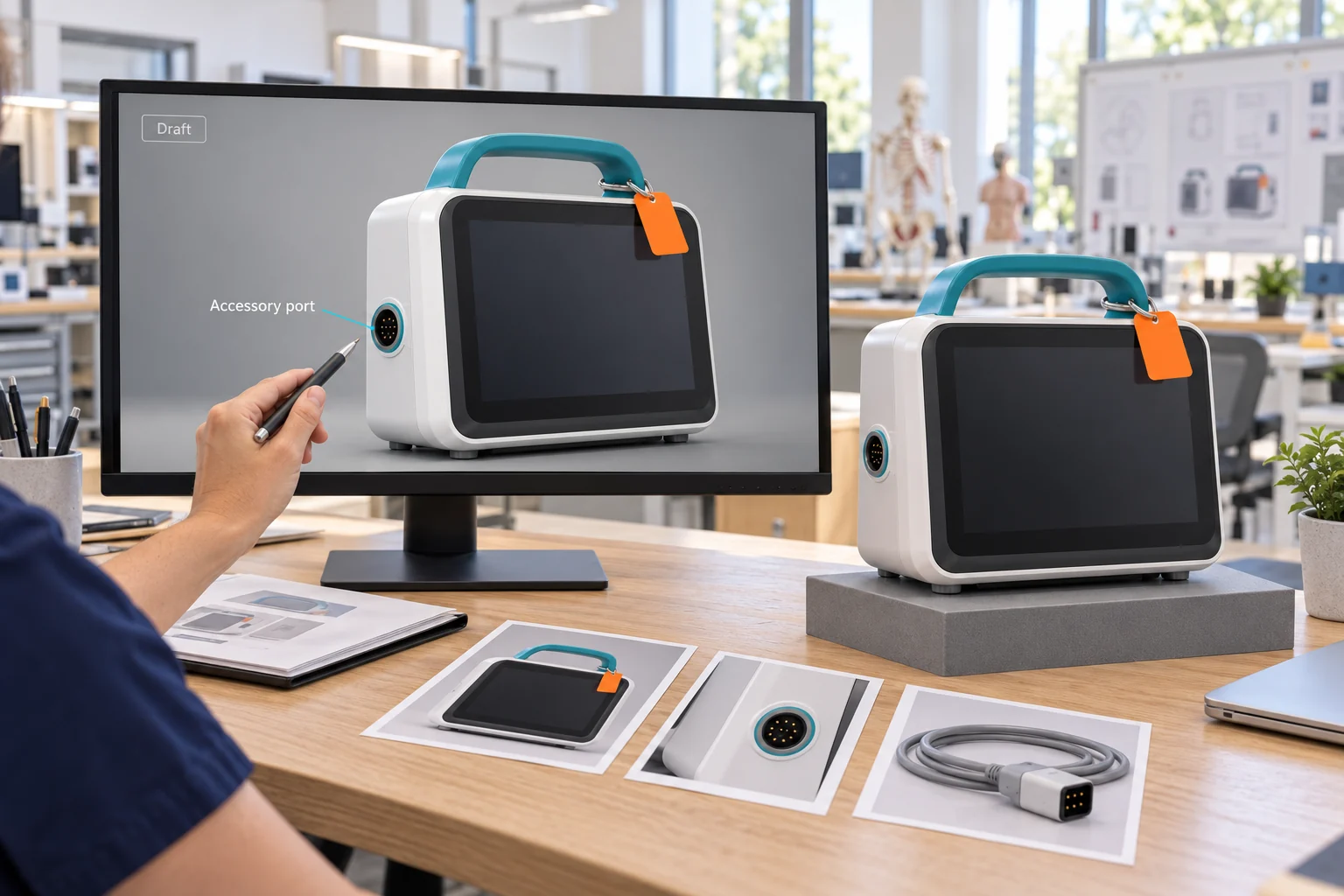
Prepare the same HCM-T01 equipment identity, permitted references and fit constraints before a source-validated model enters Genesis.
Model development
What the current source
can support.
Same equipment, all views
The source set
that is still needed.
- Permitted orthogonal front/back/left/right/top/base photos of the SAME exact trainer with scale reference
- Close macro views of P1, C-A and C-B including keys and source labels; no sensitive serial data
- Actual dimensions/coordinate convention and fixture relationship
- Approved external-motion references, start/end positions and no-go volumes
- Permission/owner record, source revision and reviewer
- Editable Mirror Direct source session and export rights
Editable prompt and acceptance
A precise model request.
Create an editable external-geometry concept of fictional HCM-T01 for nonclinical staff equipment training, using the supplied permitted reference images. Preserve the white portable housing, graphite bezel and blank screen, wide teal carry handle, stationary grey pedestal and sole circular keyed P1 port on the LEFT side. Name meshes BODY, DISPLAY, HANDLE, BASE, P1, C-A, C-B, TAG-H and NOTE, with continuous cables grouped under their respective connector. Keep round C-A separate from rectangular C-B. C-B must never seat in P1 or morph into C-A. Provide an assembled normal configuration and a held/challenge configuration with TAG-H; do not add the tag to the normal teaching branch. No patient imagery, medical traces, OEM logos, inferred internal anatomy, invented release tab, yoke tilt or clinical-ready state. Treat all dimensions and fit as unverified until the customer’s permitted measurements and reviewer-approved inert-trainer references are supplied. Export a low-poly GLB with named components, stable IDs, pivots, normals and a source/version manifest. Do not claim a native capture or validated digital twin from illustrations.